Sign up for our newsletter and get 10% off your first purchase
Duende Muses: Luiza Anyszka and the Art of Romanticizing the Everyday
Luiza Anyszka, the founder of Anyszka Studio, treats interior design like creating a personal scenography for life and shows us how to romanticize the everyday.

We are inaugurating our Journal with the "Duende Muses" series and a meeting with Luiza Anyszka — a muse, friend, and the visionary behind Anyszka Studio. Luiza teaches us how to treat interiors like our own skin and how to find room for celebration in the daily rush. In her world, "romanticizing the everyday" is not just an aesthetic choice, but a way of life. We talk about architecture that embraces you, a love for patina, and the courage to live exactly the way we want.
Mornings on old parquet floors, the scent of incense, and silk robes. Luiza Anyszka, the founder of Anyszka Studio, treats interior design like creating a personal scenography for life. In her world, architecture loses its rigid, technical dimension and gains its most human one—full of colors, scents, and textures meant to embrace us every single day. We talk with Luiza about the courage to break the rules, the beauty of patina, and how to celebrate the everyday through small, conscious choices.
Has your style changed since you shifted from structural architecture to interior design?
Definitely. Architecture is about large scale, facades, a long construction process—but it was in interiors that I found the true, human dimension. That was also when I realized I care much more about something lasting for many years, bearing the traces of use, remembering other people. To me, how light plays on the reflection of an old, crooked wall matters more than what architectural style it is.
I realized that each of us lives in our own scenography, and everything relies on small, daily choices. My approach became more sensual—I love old, creaking parquet floors; I'm glad I have a dark bedroom that wakes me up in a calm, enveloping way. I used to admire the clean, raw form of buildings. Today, at home, I primarily want to feel embraced—by color, the texture of a fabric, and even by scent.
We were recently at Salone del Mobile in Milan together. What stayed with you after that trip? What are you dreaming of now in the context of design?
Milan is my ultimate interior crush. What I envy most about the Italians is their foundation. The sheer number of old, beautiful tenement buildings, and inside them, apartments where you hardly need to change anything to feel like you're in an old movie. A beautiful sofa and fresh, cut flowers are enough—and you're already in a fairy tale. You don't need to "add anything extra" to a room with an original parquet floor and crown moldings on the walls and ceilings. The foundation is there. You can just decorate it; you don't need to reinvent the wheel. It's a completely different world from contemporary Polish developer housing.
I really wish that we in Poland would understand that "old" doesn't mean "bad." To me, it represents history and immense value. I dream that we learn to treat our interiors the way we treat life. That we dance in heels on the parquet, light candles, truly live in these spaces—and allow them to age gracefully alongside us. Every noble material looks even more beautiful after years, if we only let it.
Personally, I find it easier to design an apartment in an old residential block in Ursynów, where trees rustle outside the window on the sixth floor, than within the concrete four walls of the newest construction—soulless, without patina. But we can create that patina quite quickly simply by living in those interiors. By investing in noble materials and letting them wear in. It's the patina that gives that sense of longevity and nobility—and you can't buy that or design it in advance.
A few weeks ago, a feature was published in Vogue Living Australia showcasing your project of a tenement apartment in Wrocław. Did you have to make any difficult, risky decisions for this project?
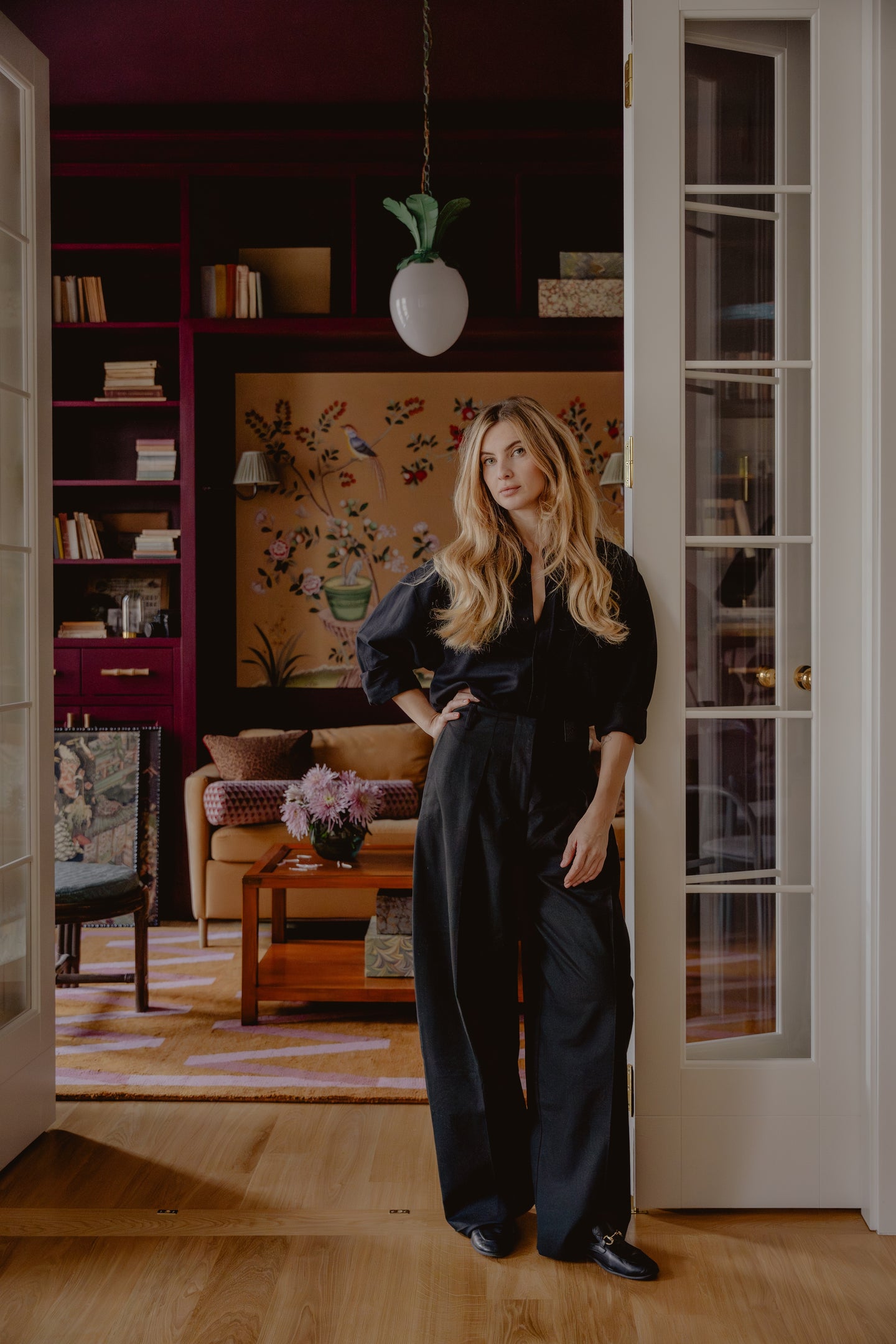
The biggest challenge was the decision to paint the study in a dark, deep color. Theory dictates that rooms facing north should be kept bright—I broke that rule and did practically everything the opposite way.
The result exceeded our wildest expectations. In this room, you can literally sink into the sofa and fully immerse yourself in reading or working. I used my absolute favorite color from Farrow & Ball there—Brinjal. And that room became the heart of the apartment, and the photograph taken in it is the most cover-worthy shot in all of my work so far.
To us, Duende is about romanticizing the everyday. How do you do that in your daily life?
For me, it's the sum of small rituals. I like walking barefoot on the old parquet in the morning, dressed in a silk robe brought back from vacation. Before I start the day, I have to light some incense and drink my favorite coffee. Cut flowers in vases are important to me—I love peonies, all bouquets that change from day to day and never look the same.
I believe everyone can create a space where they feel safe and authentic. Just as we choose our clothes every day based on who we are—we can change our surroundings in small steps to live every day like it's our most romanticized day. Because if not now, when?
That's why I live in an old tenement house—to have a touch of the Nieborów Palace every day, or of the dream old house that I will buy one day (I won't say which one it is, so no one beats me to it).
Wear silks and breezy dresses in the summer. Make a marble countertop and spill wine on it. Choose beauty, even if it's less practical. Especially if it's less practical.
Where do you most often look for inspiration when you feel you need a fresh perspective?
First and foremost, in travels—both far away and completely local. Recently, I fell in love with Naples, Florida, escaping the plastic and extravagance of the rest of the state. By chance, I walked into the Bonnet House in Fort Lauderdale and was completely lost in it. Sometimes these are deliberate journeys, and sometimes it's precisely these accidents that turn out to be the most valuable.
I love getting lost—in Rome, on a bike ride into the unknown, in palace gardens. My mother used to put my sister and me in the car, and we would drive around looking for the most beautiful houses and gardens in the area. I think that's when I learned to peek into people's windows—and I still do it today, completely without guilt.
Besides, you don't have to go far—Poland has its own treasures. I love Nieborów, Nakomiady, and Folwark Galiny. These are places that remind me that beauty and history are right next to us; you just need to know where to look.
Luiza's Favorite Places in Warsaw
-
Coffee spot: STOR, and the iconic Charlotte at Plac Zbawiciela
-
Gallery/Museum: The National Museum
-
Home decor store: NAP
-
Weekend destination: The Palace in Nieborów